As payment (electronic, e-banking, e-commerce, mobile, etc.) grows in such a manner, financial fraud is becoming more difficult to detect. With seconds to respond, fraudsters can make multiple transactions, use stolen login credentials, and adapt their approach to evade conventional fraud detection mechanisms. Organizations that rely solely on reporting historical transactions or manual review might detect suspicious activity only after the money has been lost.
That’s why real-time fraud detection is a top priority for banks, payment companies, and e-commerce companies. In the case of incoming transaction data, instead of analysing transactions hours or days later, organizations can analyse data as it is being input, identify suspicious activity in real time, and make alerts.
But implementing a good Fraud Detection System is not only a machine learning model. Businesses must have a robust data pipeline that can ingest transaction events, validate the information, compute relevant features, assess the fraud risk, and provide alerts with little latency.
Databricks offers tools to create this kind of data infrastructure. Its data processing, streaming, lakehouse, and machine learning features enable enterprises to create scalable pipelines for detecting fraud, for real-time analysis, and for historical investigation.
This guide will cover how to create a real-time fraud detection pipeline in Databricks, what technologies make it up, and what best practices should be considered to build a reliable, secure, and effective system.
What Is a Real-Time Fraud Detection Pipeline?
A real-time fraud detection pipeline is a system for processing data and scanning all incoming transactions for any potentially fraudulent transactions.
RFTD is different from the traditional batch process, in which transactions are reviewed periodically. It can issue alerts in milliseconds or seconds, depending on the architecture and requirements of the business.
For instance, a customer who pays with their payment card to buy goods in one country. Another transaction is seen a few seconds later at another place, and the transactions are not consistent with the customer’s normal activities.
A fraud detection pipeline might be able to analyze the transaction details, location, spending habits, and recent actions to decide if this new transaction needs more verification.
A fraud detection pipeline can evaluate transaction details, location, spending patterns, and recent activity to determine whether the new transaction requires additional verification.
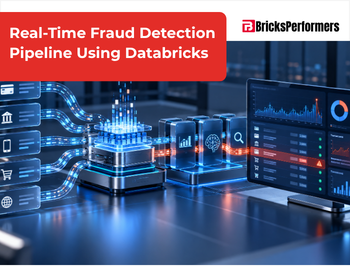
There are five key stages to a typical pipeline:
- Data ingestion: Capture payment gateway, banking system, application, and other transaction events.
- Stream processing: Filter, sanitize, and enrich data streamed in.
- Feature engineering: Compute behavioral indicators as a measure for detecting suspicious activity.
- Fraud scoring: Machine learning or business rules used for scoring the risk.
- Alert generation: Make High Risk Transactions alert for investigation, verification, and/or any other appropriate action.
With Apache Spark Structured Streaming, businesses can analyze incoming transactions and flag any suspicious activity as soon as it happens, thus enabling continuous data processing in Databricks.
Why Use Databricks for Real-Time Fraud Detection?
Fraud detection systems are required to deal with voluminous data in a timely, accurate, cost-effective, and reliable manner. In a connected environment, Databricks offers a platform that enables data engineering, analysis, and machine learning.
1. Scalable Data Processing
Payment levels, sales periods, holidays, and other events that cause high payment volumes can have a significant impact on transaction volume.
Apache Spark is being used by Databricks for processing big data on distributed computing resources. Through this, organizations can create pipelines that can respond to increasing numbers of transactions, depending on the right pipeline design and resources.
2. Streaming Data Analysis
Structured Streaming in Apache Spark is incremental—that is, it takes data as it comes in. It facilitates streaming transformations, aggregations, and integrations with supported data sources and destinations.
This allows the business to analyse the behaviour of transactions at regular intervals versus waiting for scheduled batch analysis reports.
3. A unified historical and streaming data option
It’s not always about the current transaction in and of itself, but it’s often about the previous transactions as well, and why is that? Why is it that fraud detection often relies on previous customer behaviour as well as current transaction activity?
Databricks Lakehouse Architecture enables the storage and analysis of both historical and streaming workloads. Delta Lake can offer reliable tables to store transactions, processed datasets, and for investigations.
4. Machine Learning Integration
Fraud patterns change over time. Machine learning models can discover patterns and connections between transaction attributes that cannot be easily expressed with rules.
Through its machine learning ecosystem, Databricks enables machine learning workflows for model development, evaluation, and deployment. Models can be used in combination with business rules for fraud risk scoring.
5. Data Governance and Security
Sensitive information about customers can be present in financial transaction data. Data access restrictions, monitoring, encryption, and retention rules are important for organizations.
Databricks Unity Catalog offers a centralized governance system for the assets that are supported by data and AI. These controls can be used to manage access to datasets in fraud detection when configured in an appropriate manner. I
It’s not an all-in-one solution for fraud prevention. Ensuring processes are in place to review alerts and respond to suspicious activity, and developing appropriate detection logic and integration of operational systems, are still to be done for businesses.
Build a real-time fraud detection pipeline using Databricks, Step by Step.
Step 1: Identify Transaction Data Sources
The first step is to determine the source of transaction data and the speed at which it needs to be manipulated.
Examples of common data sources are:
- Payment gateway and payment processor.
- Systems for banking and financial transactions.
- E-commerce checkout applications.
- Card authorization systems.
- Customers’ account and device activity logs.
- Historical transaction databases.
- Any external fraud intelligence services, where it’s legally and operationally appropriate.
Data for the detection process should be included in each transaction event. Common fields are transaction ID, customer ID, amount, time, merchant ID, payment type, and payment location.
Other fields can contain data relating to the device, account history, authentication outcomes, or past fraud signs.
Establish a uniform transaction schema and plan on what to do with duplicated, incomplete, and invalid events before their implementation. No matter how advanced the fraud detection model is, if the data is poorly designed, it will be less reliable.
Step 2: Load the transactions to Databricks
Determine sources and construct the ingestion layer to push transaction events into the processing pipeline.
A popular design approach is to send transaction events from payment apps to Databricks via a message broker like Apache Kafka. Other ingest methods and streaming sources may be available as well.
The payment application, for instance, may publish an event with the details of the transaction every time a customer makes a payment. Databricks consumes these events via a streaming connection and will process them on-the-fly as they hit the connection.
For data coming as files from cloud storage, Databricks Auto Loader will continuously find new files and use them as inputs for Databricks. Where transaction streams are event-driven, a messaging system might be a better option.
The ingestion layer should include the event timestamp, transaction identifiers, schema validation of the incoming data, and any pertinent data about the processing.
Additionally, it ought to be resilient toward unexpected events and not unnecessarily obscure the whole pipeline due to a single flawed record.
Step 3: Data is cleaned and validated
Raw transaction data can have missing values, duplicate events, inconsistent format, and invalid values.
Initial data quality measures should be completed on the pipeline before assessing the threat of fraud.
For instance, the system can confirm the ID of transactions, that the amount is within the technical limitations, that the time of each transaction is correct, and that the required identifiers are in the proper format.
In order to duplicate the transaction events, the right business keys and the right business logic should be applied. The system needs to be able to differentiate whether it is a duplicate event or two transactions both having the same transaction amount.
When data isn’t valid, it can be passed to a separate quarantine table to be investigated, instead of being quietly dropped.
Structured Streaming from Databricks can be used for incremental data transformations, and Delta Lake can be used to store raw and refined transaction data.
A possible lakehouse design might be to implement three data layers:
- Bronze: Raw transaction events stored for tracking and reprocessing.
- Silver: Validated, standardized, and deduplicated transaction records.
- Gold: It features curated datasets, fraud indicators, model outputs, and analytical summaries.
This way, there is a better distinction between data that comes in, cleansed records, and data ready for business consumption.
Step 4: Build Fraud Detection Features
Fraud is often an intricate scheme that is difficult to see from raw transaction data. The pipeline requires elements that provide a description of how a transaction differs from what the customer has done recently and in the past.
Feature engineering can convert transaction data into features that carry significance and can be used by a fraud detection model or rules engine to identify fraud.
Useful features include:
- Transaction velocity: Transactions that involve an account or payment instrument within a specified timeframe.
- Spending deviation: Difference between the amount of today’s transaction and the customer’s usual spending behavior.
- Geographic irregularity: Irregularities in locations, which could be a sign of fraudulent activity on an account.
- Failed payment attempts: Multiple failed attempts to pay for goods and services in a brief space of time.
- Changes of devices: Transactions from devices other than the customers normal devices. Historical risk indicators for a merchant and/or a merchant-specific risk indicator for a specific category of transactions.
For instance, a shopper may make a few high-dollar purchases in two minutes, which is not his normal way. The system can take the velocity of the transactions and deviation of the spending and use that information to determine the activity to be further evaluated.
Only information existing at the moment of the decision should be used to make the features. Leveraging future transaction outcomes or labels while training the model can lead to data leakage and misrepresent the performance of the model.
The architecture should also address late-arriving events, time windows, and the ability to reliably keep the history of customer activity.
Step 5: Develop a Fraud Detection Model
When the features are available, businesses can use a business rule, machine learning, or both to detect fraud.
For known patterns, Rule-Based Detection can be helpful. For instance, if a business sets a limit on the number of transactions that can occur in a given time frame, they could flag repeated authentication failures or excessive transactions.
Machine learning can detect more complex patterns that can be utilized through historical transactions that are marked as legitimate or fraudulent.
Common approaches include:
- Logistic regression: A fairly straightforward model that can be used for predicting the likelihood that a transaction will fall into a specific category.
- Decision trees and random forests: Models that can encode the association between the features of transactions.
- Gradient-boosted trees: Models frequently used for structured transaction data.
- Anomaly detection: Methods to identify patterns that are abnormal from a known pattern.
Fraud datasets tend to have many more legitimate transactions than fraud transactions. This class imbalance demonstrates that accuracy is not useful to assess the quality of a model in itself.
However, teams should consider Precision, Recall, False Positive rate, and the precision-recall curve. Beyond that, they need to evaluate the impact of model performance on investigation expenses and friction with customers.
The machine learning environment of Databricks can be used for model development and evaluation. This model needs to be then deployed using a suitable scoring architecture that’s capable of achieving the appropriate latency and availability requirements.
Step 6: Score Transactions and Generate Alerts
In the streaming pipeline, once the fraud model is written, it can analyze the transactions coming into the pipeline based on the features and the scoring logic.
The model can provide a fraud risk score, which can be in the range from 0 to 1. This score subsequently can be used to make sense of using thresholds set up through validation and business risk assessment.
The following categories of decisions are hypothetical for a system:
- Low risk: Proceed with a transaction with normal controls.
- Medium Risk: Ask for further verification or conduct further checks.
- High risk: Forcing the transaction as an urgent review or for a pre-configured protective action.
This is a sample list of categories. Historical data, operational requirements, and consequences of false positives and false negatives should be used to determine the actual thresholds.
The pipeline can broadcast alerts to a messaging system, add the alert to an operational database, or propagate events to an application for fraud investigation.
If the detection system is engaged in payment authorisation, latency and availability criteria for the payment platform must be met by the scoring service. An analytical pipeline operating independently of an authorization process may still be of benefit in post-transactional monitoring, even if it is not directly involved in authorization.
Step 7: Store Results for Investigation and Model Improvement
Fraud detection pipeline should keep relevant logs of transactions, features, scores, alerts, and what’s discovered upon investigation.
These records will provide information to the analysts that will help them understand the rationale for the transaction flag and determine if the flag was appropriate.
For instance, a specific pattern may often be responsible for false alarms. That information can be used to make changes to business rules, feature engineering, or model thresholds.
Outcomes from the past can also be utilized to retrain and test designs as fraud activity changes.
Organizations must keep only essential information for proper operation, analysis, and compliance, in line with retention regimes and privacy laws.
Real-World Example: Detecting Suspicious Online Payments
Imagine that a big shopping event is going on, and the e-commerce company is handling thousands of online payments per minute.
Stolen payment credentials are used to make multiple purchases through various transactions and devices. An old batch processing system might not detect the anomaly until the third purchase, for example.
The transaction events are continuously streamed through an event source into a real-time fraud detection pipeline implemented with Databricks.
It verifies each event, totals up the number of recent transactions, contrasts the purchase amount with other historical trends and patterns, and reviews the available indicator data on the device and account.
Each transaction is given a risk score by a model. If one or more of these indicators are above the set threshold, the alert is sent to the payment risk service.
The service may require more authentication, or the transaction can be sent for review, depending on the business rules.
The system also keeps transaction and decision information that may be useful for investigating and evaluating the model in the future.
This architecture can enable the business to detect suspicious activity sooner, provided that the data is of high quality, features are available, model performance is satisfactory, and the downstream architecture has a quick response.
Challenges to Consider When Building the Pipeline
Optimizing streaming speed is not enough for a successful fraud detection pipeline.
- Number of transformations, storage, external service: Each successive transformation, storage step, or external service call may cause the response time to increase. Don’t let the vital route grow inefficient.
- False positives: Too many alerts can be overwhelming for investigators, and it can cause irritation for legitimate customers. Fine-tune models and thresholds based upon operational results.
- Fraud patterns change: Fraud patterns change, and the models and rules must be constantly monitored and evaluated.
- Data Privacy: Information from transactions and customers should be securely maintained using the right access restrictions, encryption, and retention guidelines.
- Pipeline failures: These can include network outages, malformed records, and failures in the downstream service, which can disrupt processing. Use checkpointing, recovery, monitoring, and write appropriate retry behavior.
- Multiple delivery: Events can get sent to or processed multiple times. Instead of using unstable identifiers and non-idempotent downstream operations, prevent duplicate alerts and actions.
Databricks Structured Streaming also features checkpointing to aid in recovery of streaming queries and continue processing. To test failure recovery of production deployments, set up durable, query-specific checkpoints in the production.
Best Practices for Production-Ready Fraud Detection
There are a number of key practices that companies should take into account before putting the pipeline on the market.
Set measurable needs: specify processing “latency”, “throughput”, “detection performance”, “availability”, and the rate of “false positives” that are acceptable.
- Use a specific use case to start: First use one transaction type, one fraud pattern, and then add more sources or detection cases.
- Distinguish and differentiate between detection and final action: Ensure that the system responsible for scoring transactions is clearly defined by policies of authorization, verification and investigation.
- Monitor the complete pipeline: Track data freshness, processing delays, scoring failures, alert delivery, and downstream system availability.
- Guard against model drift: Keep an eye on transactions changing behavior and model performance and only retrain when the model goes through a controlled evaluation process.
- Test failure scenarios: Reproduce service outages, multiple events, delayed messages and bursty traffic.
- Optimize compute purchase and use: Buying the right size of compute resources and optimizing processing based on real needs for latency and throughput.
These practices enhance the dependability of the pipeline as transaction numbers rise over time and fraud schemes change.
Conclusion
A real-time fraud detection system in Databricks is the integration and orchestration of data ingestion, streaming analytics, feature engineering, machine learning, and alert generation.
With Databricks, businesses can leverage technologies like Apache Spark Structured Streaming, Delta Lake, and the Databricks machine learning suite to process transaction events, keep historical data up-to-date, and build a fraud detection workflow.
But technology isn’t enough to ensure accurate fraud detection. Security controls, correct features, sensible data quality and evaluation procedures, and dependable operational processes all should be a part of the data investment that an organisation should make.
With proper design and tracking a real time fraud detection pipeline can enable businesses to detect fraud sooner, cut down on manual work to investigate and act on fraud and adjust to new fraud trends.
The objective isn’t just to process transactions quicker; it’s to make them more efficient for financial institutions, payment providers and digital businesses. Its aim is to transform incoming transaction data into real-time, accurate decisions that keep customers safe and ensure secure business operations.