Modern organizations create an abundance of data through various channels, including, but not limited to, Customer Relationship Management (CRM) Systems, Enterprise Resource Planning (ERP) Systems, Website Analytics, Mobile App Usage, and Cloud Platform activity. While the generation of such data may enable companies to enhance their operational processes and make better-informed business decisions, much of the data created today is stored in separate systems which are typically not connected.
This issue is called “data silos.” Because different parts of the organization are storing data independently, it can be difficult for employees to get an overall view of how the company is operating. For example, a sales department could be storing customer data within Salesforce; a finance department could be relying upon their Enterprise Resource Planning (ERP) system; and a marketing department could be using separate analytical tools. Therefore, when you want to look at all of these sources together, it will be hard to combine them into one coherent analysis.
Traditional methods for managing data typically include transferring data from one database to another, or from a database to a data lake or data warehouse. Managing multiple systems can lead to increased operational overhead, redundant records, and slower business reporting.
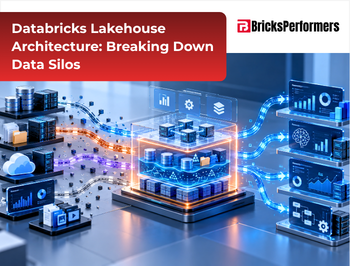
The Databricks Lakehouse Architecture is designed to solve these types of issues. A lakehouse is built on top of a data lake, but it adds features that allow organizations to effectively manage their data, perform analysis, and provide a single platform for data engineers, business analysts, data scientists, and AI developers.
We will use this article to look at data silos, the problems they cause for businesses, and how Databricks Lakehouse Architecture can assist companies with improving their data integration, governance, availability, and analytics capabilities.
What Are Data Silos?
Isolated groups of data exist as separate units in each department, application, database, and/or technology platform.
They will typically evolve because of organizations using various types of software to meet their individual business needs. Departments will select independent tools that function adequately on their own; however, these same independent tools will not be able to share information with each other.
For example, if an online retailer stores its customers’ information in a CRM (customer relationship management) application, order data in an ERP (enterprise resource planning) application, and website usage data in a separate analytics application, when managers wish to know what is causing customers to leave their shopping carts empty, the analyst will need to gather data from each of these applications.
The complexity of analyzing the data increases when the systems utilize varying formats for data, identifiers for data, and/or update schedules for data.
Common types of data silos include:
- Departmental data silos: Teams have their own individual sets of data and report-generating methods.
- Application Data Silos: Business applications contain data but lack integration.
- Cloud-based data silos: Data is spread among various cloud-based services and/or storage systems.
- Analytics silos: Businesses create different data sets for business intelligence and data science.
- Organizational data silos: Inconsistencies exist among organizations with regard to how different teams define and manage data, access policies, and operational procedures.
Organizations must have a dependable plan to integrate, govern, and share information across business units in order to break down data silos rather than just link databases together.
Why Are Data Silos a Problem for Businesses?
1. Inconsistent Business Insights
Departments’ use of disparate data sources and/or varying definitions will result in conflicting reporting.
The Sales Team, for example, will use orders completed to determine their revenue, whereas the Finance Team will report revenue based on their Accounting Policies. Management will have difficulty understanding the differences if they do not establish consistent definitions and provide adequate reconciliations.
A consistent data environment provides an organization with a means of establishing common definitions of its business processes, as well as providing its teams with dependable data sets to use in reporting.
2. Data Duplication and Higher Costs
In business, data is often copied from one application to another to allow for reporting and analysis. When this occurs over time, the copied data may be old or inconsistent with the source application.
Using many copies of a single set of data takes more room for storage, more computer power to process the data, more coordination among the copies to keep them up to date, and more supervision to make sure they are working properly.
Modern data architecture has the ability to eliminate redundant efforts by enabling multiple applications/processes to utilize the same common, controlled data resource.
3. Delayed Decision-Making
Employees who must access information from various non-integrated systems will rely on manually exporting data, creating spreadsheets, and repeatedly preparing the same data.
Slow reporting can make it hard for a company to quickly react to changes in customer behavior or to operational problems.
A well-thought-out data integration plan can provide you with access to relevant information faster so your team can make decisions with less work required on their part.
4. Limited Analytics and AI Capabilities
Artificial Intelligence (AI) and Machine Learning (ML) rely upon accurate, dependable data. If data is scattered throughout various applications, then data scientists must devote more time to gather, clean, and combine these different sources of data.
A single data platform will help simplify accessing the approved data and can be used for analytics, predictive modeling, and artificial intelligence (AI) applications.
However, simply consolidating all your organization’s data into one central location will not necessarily produce better outcomes. Your organization must ensure that it has maintained high-quality data, provided suitable levels of access control for users, and established clear lines of responsibility for managing that data.
.
What Is Databricks Lakehouse Architecture?
The Databricks Lakehouse Architecture merges the flexibility of storing data in a data lake with the data management and analytics features that are typically found in a data warehouse.
A data lake allows for storing large amounts of structured, semi-structured, and unstructured data; however, to make sure the data being analyzed is accurate and usable, an organization will need to develop appropriate processing and governance procedures.
The use of a traditional data warehouse is to support the execution of structured analytics workloads; however, creating multiple systems to manage the storage of data, as well as its analysis through data science and machine learning, will add complexity.
Organizations have a way of sharing their data through a data lakehouse architecture. This allows them to avoid moving data unnecessarily and to allow all teams access to the same data.
Several technologies contribute to the Databricks lakehouse ecosystem:
Apache Spark: A distributed processing engine designed to perform transformations and analyses on large amounts of data.
Delta Lake: An addition to the existing storage frameworks that provides additional functionality, including ACID (Atomicity, Consistency, Isolation, Durability) transactions, enforcing schemas on data, and managing tables reliably.
Unity Catalog: It is a single source of truth for all resource types with governance capabilities to control access, find data assets, and trace where data comes from (lineage).
Databricks SQL: Tools to query your data and support the requirements of your Business Intelligence programs.
Machine learning applications have capabilities to build, assess, and implement analytical models.
The combination of these technologies enables organizations to establish a unified system for data engineering, reporting, data science, and AI.
The goal of placing all your data in a single physical location isn’t the only option. In reality, the goal is to provide access to your data so that it can be found, managed, used, and reused based upon your company’s needs.
How Databricks Lakehouse Architecture Helps Break Down Data Silos
1. Creates a Unified Data Environment
A major advantage of Databricks Lakehouse Architecture is the ability for multiple teams to utilize the same data assets, rather than each team having its own copy of the same data asset to perform an analysis.
Organizations can collect data from multiple sources (such as databases, customer relationship management systems, enterprise resource planning applications, cloud-based storage solutions, and stream-of-events data) and store it in one location.
The data engineering team prepares the data, the analysis team queries the curated tables, and the data science team uses relevant data sets to train their machine learning models.
For instance, a retailer may utilize data from customer profiles, sales transactions, inventory records, and website traffic to gain insight into how customers make purchase decisions.
The company could develop a single, controlled data asset to provide sales reporting, inventory analysis, and customer segmentation rather than having to prepare separate data sets for each business unit.
This method reduces the amount of duplication that is not necessary and makes it easier to analyze across different functions.
2. Simplifies Data Integration
Data integration is about taking data from multiple places and bringing it together so that you are using consistent information.
The use of different ETL pipelines by organizations that operate in a “silo” environment can lead to difficulty in managing those pipelines as organizational needs increase. Organizations are able to utilize different ETL pipelines to move data from one application to another within their organization.
Databricks has the capability of doing both batch data processing (which is based on the use of historical data) and stream data processing (which uses real-time or near-real-time generated data).
The ability of Lakehouse Federation to allow for queries of external data sources that are supported by the Lakehouse Federation, without having to load each of the data items from those sources into the Lakehouse.
For example, a financial services company might have to analyze transaction data in conjunction with the customer data found in an entirely separate system. Based upon the needs of the company, they can either import specific data into Databricks or utilize federation to gain access to the data that is supported by Databricks.
The correct method of operation is based upon the amount of data, how well the system will function, what the source can provide, and the level of control required for governance purposes.
3. Improves Data Quality Through Medallion Architecture
The initial phase of combining data from various systems is only one part of the process. In addition, organizations will have to verify that the information they collect is reliable, uniform, and applicable for their particular purpose.
Databricks is capable of using Medallion Architecture, which is a data architecture used to organize data into 3 common layers: Bronze, Silver and Gold.
Bronze layer: Raw data
The Bronze layer will store all incoming information as is. This allows us to maintain the integrity of the source data for purposes such as verifying accuracy, validating results, and possible reprocessing at a later time.
Silver layer: Cleaned and refined data
The Silver layer contains validated and integrated data. Data engineers will be able to format the data consistently, eliminate duplicate data, fix data quality issues, and link related data elements that exist across multiple sources.
Gold layer: Business-ready data
The Gold layer contains curated data sets that are used by businesses for their reporting needs (e.g., financial reporting, customer segments, sales analysis, etc.), as well as executive dashboarding.
A retail store receives customer information from multiple sales channels. The Bronze layer receives all incoming records; the Silver layer standardizes identifiers and addresses data quality issues; the Gold layer creates data sets that are used to analyze customer purchase behavior.
The use of a layered approach allows for the transformation of disjointed data into a set of more reliable analytical resources.
4. Strengthens Data Governance and Security
In order to eliminate data silos, employees cannot have free reign over all of the company’s data.
Still, organizations have to secure confidential information, set up permissions, and follow relevant data protection rules.
Databricks Unity Catalog delivers unified governance, allowing users to centrally manage access, discover data, perform audits, and track the flow of information for all types of data and AI assets that are compatible with the catalog.
Businesses have the ability to set user and group permissions, track user and group access to data, and know how data is being generated and altered with correct configurations.
As an example, a health care provider may wish to allow analysts access to authorized operational data; however, prevent analysts from viewing any personal identification data related to patients.
Centralization of Governance helps create a uniform standard for access policy, which makes discovery of data as well as management of that data much simpler.
5. Supports Business Intelligence and Advanced Analytics
In a disconnected environment, business intelligence teams and data scientists are likely working with various copies of the same data.
Because of this, it is possible for there to be discrepancies among the dashboards, reports, and machine learning models created by these groups.
Databricks Lakehouse architecture permits the use of common data assets for all such types of workloads, with proper access control and technical requirements.
The Databricks SQL platform provides a SQL-based analytical solution, whereas the overall Databricks platform offers solutions for data engineering, data science, and machine learning.
For example, an e-commerce company could create revenue dashboards based upon curated sales data, analyze buying habits, and build a model that will help determine how likely customers are to stop buying from them.
A single data source will help eliminate duplication of effort and increase the consistency of reporting and analysis.
6. Reduces Unnecessary Data Movement
When you repeatedly copy your data from one system to another, this creates more maintenance for you. Each time you make a copy of the data, it might need to have its own separate storage, its own update/refresh schedule, its own access controls, and its own quality check.
When a system updates its data and another doesn’t, inconsistencies may occur within the two datasets.
With the help of Lakehouse Architecture, this issue can be mitigated. This can be accomplished through the use of common data storage formats (supported) that allow for the same data to be utilized by multiple workloads. This eliminates the necessity of having to create a separate copy of the data for each of the different applications.
Although this eliminates some of the data movement that takes place, there are other types of data movement that companies will continue to have to deal with, such as developing data pipelines for ingestion, developing data products specifically designed for use in specialized applications, or creating data sets optimized for specific workloads.
The objective is to allow data movement to be a planned, intentional architectural choice as opposed to being a necessity for all analytical processes.
7. Builds a Foundation for AI and Machine Learning
AI-driven applications typically need to be able to access information from different business systems. For instance, a customer support representative would likely need to have access to several different types of information, such as product documentation, open and closed support tickets, previous order histories, and all of the customer’s previous interactions with the company.
If you continue to have only these single sources, it will be harder to provide quality information to your application.
A lakehouse provides a single platform to integrate and govern information used by AI and machine learning applications.
Data Engineers can produce the dataset; Analysts can look for trends in the data; Data Scientists can create models from the accepted data.
The foundation for generative AI applications may also provide a basis for Retrieval-Augmented Generation (RAG) systems, which can retrieve pertinent data from the enterprise’s own data stores.
Organizations will need to continue addressing issues of data privacy, model evaluation, access permissions, and ongoing monitoring to responsibly employ AI.
Real-World Example: Breaking Down Data Silos in Retail
Imagine a brick-and-mortar retail business with an associated e-commerce site. The company maintains customer data through its CRM, tracks product stock levels through its ERP system, and processes all of its online sales via another data repository.
Marketing teams struggle to know what types of marketing campaigns produce the best quality customers, as customer engagement in marketing campaigns and sales generated by those campaigns remain separate. Additionally, inventory managers do not have a single source of demand from both the internet (online) and physical locations (offline).
The firm uses Databricks Lakehouse Architecture to build a more integrated data infrastructure.
First, it pulls together specific data from its current systems into a common area. Unprocessed records are placed into the Bronze layer so that they can be processed.
Then, the company makes sure that all of its customers’ identification is consistent, verifies that each transaction recorded was valid, and links together its inventory data in the Silver layer. The final Gold layer provides business-ready data sets to analyze campaigns, product demand, and customer purchase behaviors.
The Unity Catalog is used to manage access to each dataset. Each dataset can be accessed by various individuals within the organization. In addition, Databricks SQL is used for creating reports and dashboards from the datasets.
The Marketing Team can assess Campaign Results in Relation to Sales Outcomes. Inventory Managers can Assess Demand from All Sales Channels. Data Scientists can Assess Purchasing Trends to Forecast.
The organization requires clarity on data definitions, quality checks, and operational procedures. However, the lakehouse provides an underlying technical infrastructure that allows for better coordination of cross-functional analyses.
Best Practices for Implementing Databricks Lakehouse Architecture
The success of a technology platform will depend upon whether an organization has established clear priorities and then designed the environment in relation to what is required for the business to function.
Select an important business issue. Find out what kind of problems exist, such as delays in getting reports done, multiple sets of identical data, and/or difficulty integrating systems which have the most significant effect on your operations. Focus on one specific area (use case) rather than attempting to move all of your systems at once.
Identify existing data resources. Note the locations of essential data; the owners of such data; the frequency of change of this data; and the groups that rely upon the use of these data.
Data ownership and governance should be defined. Responsibilities for data quality, access permissions, retention and compliance should be established. Unity Catalog and its associated controls should be configured in accordance with organizational needs.
Use a systematic method for processing data. Separate raw data into Bronze, Silver and Gold levels, as required, in order to create validated and business-ready sets of data.
Avoid duplicate data. Determine if your team is able to leverage common, governed data resources as opposed to creating and managing its own copy of those same resources. However, you should create separate copies of the data if there are technical, regulatory, or business reasons why that would be beneficial.
Track performance and quality. Monitor for pipeline failures, freshness of data, changes in schemas, performance of queries, and cost to process data.
Evaluate business outcomes. Determine if the new system has reduced reporting delays, improved reporting consistency, eliminated non-value-added processing expenses, or increased speed of analytical projects.
Organizations can achieve a better data management strategy, as opposed to just having all their data in one place, by implementing these practices.
Conclusion
The main obstacle to organizations using data from various sources (applications, departments, platforms) are the data silos. These isolated systems can produce redundant data, varying reports, increased maintenance costs, and restrictions on using advanced analysis.
Lakehouse Architecture from Databricks provides an effective way to address the above issues through a combination of scalable data storage, reliable data management, integrated processing and central control.
Organizations can use technologies like Delta Lake, Unity Catalog, and Medallion Architecture to improve data integration, enhance data quality, minimize redundant data, and provide easier access to trusted information for various teams.
However, technology itself does not eliminate all data silos. To do so requires a clear understanding of who owns what data; common business terminology throughout an organization; good governance; and a well thought-out implementation plan.
For companies who want a better-connected and analytics-ready environment, Databricks Lakehouse Architecture offers the opportunity to break through the data silos and turn fragmented data into business-actionable insights.