You may be collecting data from more sources than you know within your business. Every day, information is created, and it can be used in multiple ways, including customer transactions, websites, applications, databases, devices, APIs, and internal systems.
The problem arises when this data is spread out on multiple platforms.
You might have one system to process your data in your data engineering team. Another platform may be the basis for the analytics your team relies on. Machine learning teams might require something else this time around. It can become costly and challenging to handle these disjointed environments as your data increases.
This is where Databricks comes in. However, how exactly does Databricks operate? So, why do organizations use it for modern data workloads?
Let’s take it apart.
What Is Databricks?
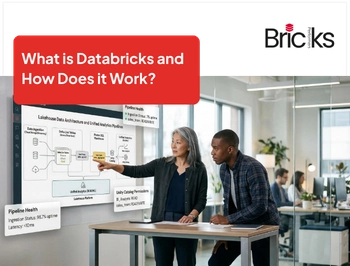
Databricks is a single platform for data engineering, analytics, machine learning, AI, and data governance all on a cloud-based platform. It is designed around a lakehouse to enable you to develop and manage various data sets without requiring completely different environments for each data workload.
Don’t always have to drag the same data from one silo to another from a variety of platforms just because different teams need to access it. It’s worth noting another component of Databricks architecture: separation of storage and compute.
You can store your data in cloud object storage, and Databricks has the computational capabilities to process and analyze your data. This enables to scale processing according to the workload while keeping storage separate.
Databricks is supported on all major cloud platforms: AWS, Microsoft Azure, and Google Cloud.
What is a Databricks Lakehouse?
The Databricks Lakehouse is the core of the platform. The concept is easiest to grasp when you consider using a traditional data lake and a traditional data warehouse individually. A data lake provides you flexible and scalable storage of various types of data. A data warehouse is typically used for structured analytics and reporting.
With a lakehouse, you can use a shared and governed data foundation for:
- Data engineering
- Business intelligence
- Machine learning
- Artificial intelligence
- Analytics
- Data governance
The Databricks lakehouse leverages technologies like Apache Spark, Delta Lake, and Apache Unified Governance for Cataloging to support processing, reliable storage, governance, and analytics. When multiple teams share the same data, and each has different workloads, this can make a difference for you.
How Does Databricks Work?
Typically begins with ingestion of data into the lakehouse environment from various sources. You may have data in a database, business application, file, sensor, API, log or other system. Could come in as batch processes or streaming workflows. The lakehouse data can then be processed, transformed, organized, governed, and analyzed.
A simplified Databricks workflow is as shown below:
- Sources of data: Data collected from databases, applications, files, APIs, IoT devices, logs and other systems.
- Data ingestion: Data comes into the lakehouse: batch or streaming.
- Data storage: Data will be stored in cloud object storage, usually in the form of Delta Lake tables.
- Data processing: Apache Spark and Databricks compute resources process and transform the data.
- Refine data: Data can flow between bronze, silver, and gold layers.
- Data governance: Unity Catalog helps manage access control, discovery, auditing, and lineage.
- Analytics and BI: Teams have access to processed data and can run queries on it from Databricks SQL.
- Machine learning and AI workloads: Data scientists can run both machine learning and AI workloads in the same environment.
- Business consumption: refined data will inform dashboards, reports, apps, AI solutions and business decisions.
The key is the shared data foundation of these stages, not the identity of each team being an isolated environment.
Key Technologies Behind Databricks
Databricks combines multiple technologies to enable today’s cutting-edge data workloads. They all serve different functions in the platform as a whole.
Apache Spark
Many Databricks workloads are based on the distributed processing capabilities of Apache Spark. It enables you to perform computations on large amounts of data using scalable compute resources. It can be utilized for data transformation, engineering pipelines or other large-scale processing jobs.
In addition to SQL, Databricks offers collaborative notebooks and data engineering and machine learning capabilities.
Delta Lake
Lakehouse tables are stored in Delta Lake. It appends a transaction log to Parquet files and has features like ACID transactions and enforcing schema. It also provides solid batch and streaming capabilities.
Unity Catalog
The governance layer is provided by Unity Catalog. It enables the orchestration of data and AI resources:
- Access control
- Data discovery
- Data lineage
- Auditing
- Governance
Data governance becomes more critical as your data environment expands. Your team should be aware of the kinds of data available, the kinds of sources from which it comes, and who can use it.
Unveiling How Databricks Processes Data
The common method of defining information in Databricks is the medallion structure. It’s a concept that’s easy to grasp. As the data flows through various layers, it becomes cleaner and more useful.
Bronze Layer
Data in the bronze layer is either raw or only slightly transformed. One example of a business that would import this data into the layer is an e-commerce organization utilizing customer purchases, site activity, product info, and other source data. The goal at this point is not to make the data ‘business ready,’ but to record it.
Silver Layer
Cleaned and refined data is in the silver layer. Your data engineers can clean your information, eliminate inconsistencies, join datasets, and prepare your information for downstream.
Gold Layer
Business-ready data is a part of the gold layer. This data can be used to support report creation, dashboards, customer analysis, forecasting, and recommendation systems, and many other workloads for business.
An e-commerce business may begin with raw transaction data and website data in the bronze layer, for instance. This information can then be filtered and integrated in the top layer of silver. Lastly, the gold layer may include data sets that have been created to cater to sales dashboards or customer analysis.
In this way, your team can incrementally refine their data quality over time and ensure they have a traceable data journey from the source to the business-ready data.
What Can Databricks Be Used For?
Databricks is intended to enable a variety of modern data and AI applications. The platform can be used for:
- Data engineering: Develop and maintain large-scale data workflows.
- Data warehouse: Perform SQL-based analytics and business intelligence applications.
- Data lakehouse: Consolidate and process many different types of data.
- Machine learning: Create training sets and create machine learning workflows.
- Generative AI: Create AI applications and workflows with enterprise data.
- Real-Time Analytics: Stream of data for any near real-time use case.
- Data governance: Control access, discovery, lineage and auditing.
- Business intelligence: Develop dashboards and analytics on datasets under governance.
The right use case will be determined by the desired outcome. A company with real-time analytics platforms could have vastly different needs, as compared to a company building learning pipelines or modernizing an existing data warehouse.
Why Do Organizations Use Databricks?
One primary use of Databricks is for supporting the coalescing of various data workloads. Without a common environment, you might be reliant on separate systems for data engineering, analytics, reporting, and AI applications. That may cause further data transfer and duplication.
The lakehouse offers a common data foundation, which allows them to collaborate across teams. This can help simplify engineering, analytics and AI processes. Separating compute from storage, too, is a feature of Databricks. Processes can be scaled as per the requirement without moving the actual data to different cloud storage.
It’s governed with centralized controls and data is made reliable with Delta Lake in the lakehouse. When combined, these features provide a foundation for organizations to develop robust data and AI-based solutions that are scalable.
Databricks Architecture in Simple Terms
For those who are new to Databricks, learning the Databricks architecture can be broken down into three broad categories: storage, compute, and governance. Cloud storage offers long-term data storage solutions. Those resources analyze and compute that data. Governance services help to manage and control how your data and AI assets are accessed and managed.
Databricks workspaces are collaborative spaces where your teams can work on data ingestion, data processing, data analytics, scheduled jobs, and machine learning workloads.
It enables various teams to access a common data foundation from their tools and compute resources that are most suitable for their workloads.
Final Thoughts
Databricks is more than just a platform for processing large data sets. It offers a single solution for data, analytical, machine learning, AI, and governance capabilities, all built around a lakehouse architecture.
Databricks’ connected data environment is made possible by scalable compute, cloud storage, Apache Spark, Delta Lake, Apache Unity Catalog, and analytics capabilities so that organizations can avoid having siloed environments for each workload.
The architecture is as important as the platform if you are in a process of implementing, migrating, or building a lakehouse with Databricks or a data modernization project.